WiMAX or LTE (long-term evolution) – which is superior? It, of course, depends on who you talk to. The vendors have their own stories, and the operators theirs. For the consumers, it is not about technology. It is about speed and seamless connectivity, and not having to buy different devices to operate on different platforms.
From the technical viewpoint, both are next-generation technologies for the wireless world. The choice between WiMAX and LTE hinges on the needs of the operator and the market demands, but the fact is, there seemingly is an insatiable appetite for data on the go.
WiMAX (worldwide interoperability for microwave access) is a fourth-generation (4G) telecommunications technology primarily for fast broadband.
Also a 4G mobile technology, LTE allows a peak download speed of 100 megabits per second (Mbps) on mobile phones, compared with 20Mbps for 3G and 40Mbps for WiMAX.
“For operators, the choice of technology depends on a number of things including available spectrum, legacy inter-working, timing and business focus,” says Nokia Siemens Networks head of sub region, Asia South, Lars Biese.
To deploy either technology, operators will have to commit tens of billions of dollars in network upgrades for the new mobility landscape, which now includes social, video, location-based and entertainment applications and experiences.
In many countries, the current generation of mobile telecoms networks is 3G. Those in Malaysia are deployed by the four mobile players – Celcom Axiata Bhd, DiGi.Com Bhd, Maxis Communications Bhd and U Mobile Sdn Bhd.
Biese reckons LTE is the next step for mobile networks like GSM, WCDMA/HSPA and CDMA in the move to future networks and services.
The common belief is that the natural migration path is from 2G to GPRS, from GPRS to 3G, and from 3G to LTE. But IDC Asia/Pacific’s telecom research director Bill Rojas has a differing view. To him, LTE is a totally new set-up.
“GSM and GPRS were part of a migration. In Asia, the players may put LTE on top of 3G, but this will not cover the entire population. The concentration will be on urban centres. For full coverage, the operator needs to build more than 30% new cell sites,” Rojas says.
It has been reported that LTE’s main advantage over WiMAX, in addition to speed, is that it is part of the popular GSM technology and can allow backward compatibility with both 2G and 3G networks.
LTE is relatively new compared with WiMAX. The world’s first public LTE service was made available only at the end of last year by TeliaSonera in Stockholm and Oslo.
Some people may said that LTE means "Late To Evolve"... However, LTE is fast catching up with WiMAX even though the WiMAX Forum, an industry organisation, stresses that its platform is at least two years ahead in terms of equipment availability and testing.
The Global Suppliers Association (GSA) says there are more than 59 LTE network commitments in 28 countries. In comparison, according to the WiMAX Forum, there are 559 WiMAX networks worldwide.
“To date, all existing GSM and WCDMA (3GPP) operators and CDMA (3GPP2) operators have committed to LTE as the technology of choice for their mobile network evolution, and by 2013, it is expected that there will be 20.4 million connections activated on LTE in the Asia Pacific,” says Biese.
On the other hand, YTL Communications Sdn Bhd chief executive officer Wing K Lee claims that mobile WiMAX is the only commercially proven technology that has been deployed on a large scale.
Nevertheless, market dynamics will determine the outcome of the race.
There are four WiMAX spectrum holders in Malaysia, namely, Packet One Networks (M) Sdn Bhd, REDtone International Bhd, Asiaspace Sdn Bhd and YTL Communications, which is the only one that has yet to roll out services commercially.
Rojas of IDC says both technologies can co-exist, but to him, WiMAX is still the purest 4G network. Naturally, the promoters of LTE have the opposite view.
That aside, Lee of YTL Communications points out that LTE and WiMAX serve the wireless broadband market and both technologies fundamentally share the same technological foundation. Therefore, they have more similarities than differences.
Should they then be merged, as suggested by US-based Clearwire CEO Bill Morrow, given the overlap in the technologies?
While the debate rages on, the mobile operators in Malaysia still have a little bit of time to decide on which route to take to add capacity. This is because they have not fully exhausted their 3G spectrum. Even the WiMAX players have not fully exploited their 2.3G spectrum.
At some point, Rojas believes, the Malaysian Government will have to decide on spectrum allocation for LTE. Until then, do not expect the operators to fast-track their network expansion, even though some may face bottlenecks soon.
Furthermore, the Government needs to be certain that LTE is what the market needs. “Without (additional) spectrum after 3G, operators will have to move to LTE using the 3G spectrum,’’ Rojas says.
Whatever is on the minds of the players and industry regulators, one thing is clear – the need for speed is growing by the day, and the planning for spectrum allocation should start before we hit bottlenecks.
Some industry players have also called for the Government to refarm spectrum so that there is a coordinated approach to spectrum allocation and assignment. Not that there isn’t, but given that spectrum is becoming a rare commodity, the Government should make sure that the spectrum awarded is put to good use.
Rojas expects major commercial roll-outs of LTE and WiMAX in Asia this year and next, but devices remain an issue in the world of 4G. At the same time, experts say it is about time that the industry focuses on a single device that works on all platforms.
Saturday, April 24, 2010
Wednesday, April 21, 2010
Nexus One: the second choice after iPhone (Blackberry and Nokia is not a contender)
Google’s Nexus One not only looks the part but comes with enough firepower to make it a serious contender for the iPhone 3GS crown, (after Blackberry and Nokia N800 lost to iPhone).
 What’s really special about this particular smartphone model is that it runs on the latest Android 2.1 operating system, and has many tricks under its sleeve to compete head on with the iPhone 3GS.
Currently, the Nexus One is only available through the Google website for US$529 (RM1,690) and although the company ships the smartphone internationally, Malaysia is not on the list.
The phone is only 11.5mm thick, the Nexus One generally feels slimmer and sleeker than the iPhone. (It is however about 4.5mm taller than the iPhone.)
The glass-covered front is monopolised by the 3.7in capacitive touchscreen, which has a 480 x 800-pixel resolution.
The display looks awesome with colours that appear to jump right at you. But, like similar screens, it fares poorly under direct sunlight and is also a fingerprint and smudge magnet.

Useful as they are, we still found the layout to be somewhat annoying as we kept accidentally tapping them while texting, composing an e-mail message or when playing games.
Further down there is a glowing trackball to navigate and access the phone’s features.
Most users complain that apart from doubling as the camera button and notification light, there’s literally not much use in having it around.
After all, to navigate anywhere on the screen you can simply use your finger. And it’s faster that way too, we might add.
To be fair, however, we did find the trackball handy when playing games. It can be used to navigate in a game, enabling you to take one thumb off the screen, thus providing a bigger viewing area.
In comparison, on the iPhone you need to place both thumbs on the screen especially when playing racing games. This essentially blocks a large portion of the display from the eyes.
Moving on, along the left side you will see the volume rocker while up on top are the power button and a 3.5mm headphone jack. Naturally, the back is where you will find the 5-megapixel camera with LED flash.
Other features include light and proximity sensors, accelerometer, HSDPA, WiFi, A-GPS and a microSD slot with a 4GB card included.
The Nexus One only offers 512MB Flash memory and 512MB RAM to run and store data as well as applications. There is a microSD card slot but unfortunately it is only to store data files.

Also available are those that respond directly to touch, such as the Nexus neural network to create more colour lines as well as water that ripples.
Some like it, others don’t but one thing’s for sure — despite being a novelty feature that you would get tired of after a while, the animated wallpaper is still one of the cool functions that would attract people when they first look at the smartphone.
The Nexus One offers up to five homescreens, which you can add and delete shortcut icons, folders and widgets at will. The upper left hand corner of the screen is reserved for notifications.
Just like the iPhone, you only have a virtual keyboard and the spacing of the keys are narrower than the former. This poses a problem in the form of lots of mistyping.
There is no option to increase its width so you are stuck with the default layout.
Excellent touch-sensitivity is not the only feature that closely rivals the iPhone. The Android Market is another — an online marketplace that is what the App Store is to Apple’s iPhone. So far, Nexus got much smaller number of apps than the Apple Store for iPhone.
Anyway, we still can pick from games like Robo Defense and Gem Miner to must-have tools such as metal detectors and digital levels; as well as all social networking and instant messaging mobile editions.

Also, Google doesn’t restrict users to apps that are only available on its Android Market. Being an advocate of an open platform, the company also allows users to install software directly from developer sites outside of the marketplace.
On the iPhone you can only do so if you “jailbreak” the device first — a move which is clearly not supported by Apple.
Also unlike the iPhone platform, Android apps are able to run in the background. So, if you accidentally pressed the back button, the app that you’ve already opened will still be where you left it when you come back.
Of course, the Nexus One works tightly with Google apps such as Sky Map. If you want to find out which constellation you are currently looking at, just point the smartphone to the night sky. It that cool or what?
Note however that only free apps are accessible for now as Google needs to work out the billing deal with local carriers first before the paid versions will be made available.
In other words, the smartphone itself needs to be officially available here before that can happen.
A sleek shooter
The camera department is another section in which the smartphone shines. Its 5-megapixel shooter is able to produce above average pictures compared to other camera phones we have used to date.
There are also autofocus, white balance, colour effect controls, digital zoom and three quality settings to help users take better pictures.
Overall images captured were clear and offered vivid colours. Images were also very detailed and low light performance was generally good. There was an element of graininess but this is to be expected from a camera phone.
With the built-in A-GPS you can also geotag your shots for your reference.
The Nexus One’s imaging capabilities don’t end there though, as it also features very capable video recording at up to 720 x 480-pixel resolution at 20 frames per second.
Colour reproduction is good and footage is pretty clear.
Beyond voice dialling
Like most smartphones in the market, Nexus One also supports voice dialling but the technology goes beyond that, offering users an enhanced voice recognition capability to enable them to simply speak to input text.
So when you don’t feel like typing, just press the microphone icon in supported applications to dictate your texts, e-mail, searches, notes and others.
Google Speech Recognition is tightly integrated into Android 2.1 on the Nexus One so to use this feature the phone must connect to the Internet as that’s where the transcribing is done.
It recognises several languages. However, most Malaysians can probably only choose either UK or US English as the option unless you can speak French, German, Italian or Spanish as well.
The accuracy is patchy, at about 60% to 70% success rate. Plus, you would also need to speak slowly and enunciate everything properly. Surprisingly, we got better results in the US English option.
As a phone, the Nexus One isn’t dramatically different from most GSM devices you have probably used. Suffice to say that the call quality is at par with others.
The dynamic noise suppression option is a surprising addition though. The feature makes use of the second microphone located at the phone’s back to isolate background noise from your voice when making calls.
Compared to other “tend to be an iPhone-killers” that have been positioned to dethrone the king, the Nexus One is probably the closest one to be able to do so at the moment after Nokia and Blackberry lost the battle.
It offers many of the iPhone 3GS advantages and more including fast operation, gorgeous display, elegant design, decent camera, plenty of apps to download and customise. Plus we also welcome its voice recognition capability.
However, it is not without its problems. For starters, application storage remains limited to the internal memory.
Of course, being a trendsetter also means you usually need to pay a higher price to be among the first to secure the phone. Price probably in the range of — RM2,500 - RM 2,800. I'm not sure how much the Low Yatt will mark up later.
The Android and iPhone platforms can be similar and yet vastly different. (Hint: Windows Mobile is the worse) There are also things beyond the technology platform such as brand loyalty — so at the end of the day it all boils down to what you consider the more important value when choosing one over the other.
Currently, the Nexus One is only available through the Google website for US$529 (RM1,690) and although the company ships the smartphone internationally, Malaysia is not on the list.
The phone is only 11.5mm thick, the Nexus One generally feels slimmer and sleeker than the iPhone. (It is however about 4.5mm taller than the iPhone.)
The glass-covered front is monopolised by the 3.7in capacitive touchscreen, which has a 480 x 800-pixel resolution.
The display looks awesome with colours that appear to jump right at you. But, like similar screens, it fares poorly under direct sunlight and is also a fingerprint and smudge magnet.
TOO CLOSE: Useful as they are, the four touch-sensitive buttons are too close to the screen. Users would consistently tap the wrong buttons while texting or composing an e-mail, and even when playing games.
There are four touch-sensitive buttons placed slightly at the bottom of the screen for Back, Menu, Home, and Search functions.Useful as they are, we still found the layout to be somewhat annoying as we kept accidentally tapping them while texting, composing an e-mail message or when playing games.
Further down there is a glowing trackball to navigate and access the phone’s features.
Most users complain that apart from doubling as the camera button and notification light, there’s literally not much use in having it around.
After all, to navigate anywhere on the screen you can simply use your finger. And it’s faster that way too, we might add.
To be fair, however, we did find the trackball handy when playing games. It can be used to navigate in a game, enabling you to take one thumb off the screen, thus providing a bigger viewing area.
In comparison, on the iPhone you need to place both thumbs on the screen especially when playing racing games. This essentially blocks a large portion of the display from the eyes.
Moving on, along the left side you will see the volume rocker while up on top are the power button and a 3.5mm headphone jack. Naturally, the back is where you will find the 5-megapixel camera with LED flash.
Other features include light and proximity sensors, accelerometer, HSDPA, WiFi, A-GPS and a microSD slot with a 4GB card included.
The Nexus One only offers 512MB Flash memory and 512MB RAM to run and store data as well as applications. There is a microSD card slot but unfortunately it is only to store data files.
STACK THEM UP: The Nexus One (on top) is 0.8mm thinner but 4mm lengthier than the iPhone 3GS.
There are plenty to choose from, including a swirling galaxy; blades of waving grass; and an analogue sound meter with a needle that moves to the music you’re playing.Also available are those that respond directly to touch, such as the Nexus neural network to create more colour lines as well as water that ripples.
Some like it, others don’t but one thing’s for sure — despite being a novelty feature that you would get tired of after a while, the animated wallpaper is still one of the cool functions that would attract people when they first look at the smartphone.
The Nexus One offers up to five homescreens, which you can add and delete shortcut icons, folders and widgets at will. The upper left hand corner of the screen is reserved for notifications.
Just like the iPhone, you only have a virtual keyboard and the spacing of the keys are narrower than the former. This poses a problem in the form of lots of mistyping.
There is no option to increase its width so you are stuck with the default layout.
Excellent touch-sensitivity is not the only feature that closely rivals the iPhone. The Android Market is another — an online marketplace that is what the App Store is to Apple’s iPhone. So far, Nexus got much smaller number of apps than the Apple Store for iPhone.
Anyway, we still can pick from games like Robo Defense and Gem Miner to must-have tools such as metal detectors and digital levels; as well as all social networking and instant messaging mobile editions.
ROLL TO NAVIGATE: Only one finger needs to be on the screen when playing games as a user can also use the trackball to navigate.
And they all work just as well as the iPhone versions, we might add.Also, Google doesn’t restrict users to apps that are only available on its Android Market. Being an advocate of an open platform, the company also allows users to install software directly from developer sites outside of the marketplace.
On the iPhone you can only do so if you “jailbreak” the device first — a move which is clearly not supported by Apple.
Also unlike the iPhone platform, Android apps are able to run in the background. So, if you accidentally pressed the back button, the app that you’ve already opened will still be where you left it when you come back.
Of course, the Nexus One works tightly with Google apps such as Sky Map. If you want to find out which constellation you are currently looking at, just point the smartphone to the night sky. It that cool or what?
Note however that only free apps are accessible for now as Google needs to work out the billing deal with local carriers first before the paid versions will be made available.
In other words, the smartphone itself needs to be officially available here before that can happen.
A sleek shooter
The camera department is another section in which the smartphone shines. Its 5-megapixel shooter is able to produce above average pictures compared to other camera phones we have used to date.
There are also autofocus, white balance, colour effect controls, digital zoom and three quality settings to help users take better pictures.
Overall images captured were clear and offered vivid colours. Images were also very detailed and low light performance was generally good. There was an element of graininess but this is to be expected from a camera phone.
With the built-in A-GPS you can also geotag your shots for your reference.
The Nexus One’s imaging capabilities don’t end there though, as it also features very capable video recording at up to 720 x 480-pixel resolution at 20 frames per second.
Colour reproduction is good and footage is pretty clear.
Beyond voice dialling
Like most smartphones in the market, Nexus One also supports voice dialling but the technology goes beyond that, offering users an enhanced voice recognition capability to enable them to simply speak to input text.
So when you don’t feel like typing, just press the microphone icon in supported applications to dictate your texts, e-mail, searches, notes and others.
Google Speech Recognition is tightly integrated into Android 2.1 on the Nexus One so to use this feature the phone must connect to the Internet as that’s where the transcribing is done.
It recognises several languages. However, most Malaysians can probably only choose either UK or US English as the option unless you can speak French, German, Italian or Spanish as well.
The accuracy is patchy, at about 60% to 70% success rate. Plus, you would also need to speak slowly and enunciate everything properly. Surprisingly, we got better results in the US English option.
As a phone, the Nexus One isn’t dramatically different from most GSM devices you have probably used. Suffice to say that the call quality is at par with others.
The dynamic noise suppression option is a surprising addition though. The feature makes use of the second microphone located at the phone’s back to isolate background noise from your voice when making calls.
Compared to other “tend to be an iPhone-killers” that have been positioned to dethrone the king, the Nexus One is probably the closest one to be able to do so at the moment after Nokia and Blackberry lost the battle.
It offers many of the iPhone 3GS advantages and more including fast operation, gorgeous display, elegant design, decent camera, plenty of apps to download and customise. Plus we also welcome its voice recognition capability.
However, it is not without its problems. For starters, application storage remains limited to the internal memory.
Of course, being a trendsetter also means you usually need to pay a higher price to be among the first to secure the phone. Price probably in the range of — RM2,500 - RM 2,800. I'm not sure how much the Low Yatt will mark up later.
The Android and iPhone platforms can be similar and yet vastly different. (Hint: Windows Mobile is the worse) There are also things beyond the technology platform such as brand loyalty — so at the end of the day it all boils down to what you consider the more important value when choosing one over the other.
NEXUS ONE
OPERATING SYSTEM: Android 2.1
CAMERA: 5-megapixels
DISPLAY: 3.7in 16.7mil colours AMOLED, 800 x 480-pixel resolution
MESSAGING: MMS, SMS, e-mail
CONNECTIVITY: Bluetooth, 3G, HSDPA
PHONE MEMORY: 512MB Flash, 512MB RAM
EXPANSION SLOT: microSD, 8GB card included
BATTERY TYPE: 1,400mAh lithium-ion
STANDBY/TALK TIME: 250/7 hours (on 3G)
OTHER FEATURES: A2DP stereo Bluetooth, haptic feedback, second microphone for dynamic noise suppression, proximity sensor, light sensor
DIMENSIONS (W x D x H): 59.8 x 11.5 x 119mm
WEIGHT: 130g
PREDICTED PRICE: RM2,500 - RM 2,800

Monday, April 19, 2010
AMD based netbook , Why there are always late
It is already well known that AMD has their own bechmark in high end computing product, especially for games and graphical works ( though I think Apple got extra mark on the second). However, they should not just ignore the huge desire from middle and lower rank users, which could contribute narrowing the gap between its competitor, Mr. Intel.
As I always said, AMD should go after the gaping hole between netbooks and thin-and-lights by releasing a low-power platform with solid graphics abilities, and it looks like the company’s finally coming around — AMD’s John Taylor just told us that the chipmaker will be releasing a netbook-class Fusion CPU / GPU hybrid codenamed “Ontario” with integrated DX11 graphics sometime next year. If Ontario sounds familiar, it’s because we’ve seen it leaked in the past — it’s a part of the “Brazos” platform built around the low-power Bobcat core. Of course, AMD has been promising Fusion chips of all stripes for years now without a single shipping part, so saying that a Fusion chip will get it into the netbook game in 2011 is mildly amusing — while AMD’s definitely turned things around, it’s still incredibly late to the low-end party, and Intel’s solidly beaten it to the hybrid CPU / GPU punch with the Core 2010 and Pine Trail Atom chips. Add in the fact that NVIDIA’s Optimus-based Ion 2 chipset seemingly offers the extended battery life of Atom with the performance of a discrete GPU, and we’d say the market niche Ontario is designed to fill may not actually be so niche when it finally arrives. We’ll see what happens — a year is a long, long time.
As I always said, AMD should go after the gaping hole between netbooks and thin-and-lights by releasing a low-power platform with solid graphics abilities, and it looks like the company’s finally coming around — AMD’s John Taylor just told us that the chipmaker will be releasing a netbook-class Fusion CPU / GPU hybrid codenamed “Ontario” with integrated DX11 graphics sometime next year. If Ontario sounds familiar, it’s because we’ve seen it leaked in the past — it’s a part of the “Brazos” platform built around the low-power Bobcat core. Of course, AMD has been promising Fusion chips of all stripes for years now without a single shipping part, so saying that a Fusion chip will get it into the netbook game in 2011 is mildly amusing — while AMD’s definitely turned things around, it’s still incredibly late to the low-end party, and Intel’s solidly beaten it to the hybrid CPU / GPU punch with the Core 2010 and Pine Trail Atom chips. Add in the fact that NVIDIA’s Optimus-based Ion 2 chipset seemingly offers the extended battery life of Atom with the performance of a discrete GPU, and we’d say the market niche Ontario is designed to fill may not actually be so niche when it finally arrives. We’ll see what happens — a year is a long, long time.
Sunday, April 18, 2010
Review of Vector Linux
Based on Slackware, VectorLinux was originally all about being a small, self-contained and easy to install and use distro. Since it started life in 2000 it has been through many different iterations and sprouted a few different variants (SOHO, Light, Standard, Live) to target specific use scenarios.

Development tools and the kernel source can be excluded to give you change, but we don't recommend you install this on anything smaller than a 4GB drive if you want some swap space (which you do on a low-memory system) and room to store your files.
In terms of app choice, things are skewed towards web and media stuff. There are four web browsers, but only Leafpad, Pathetic Writer and Siag Office by way of office programs, and MTPaint holding up the graphics end of the ship.
Installing VectorLinux is straightforward for a veteran of pre-Ubuntu installers. This Curses-based trip back into prehistory actually has the temerity to ask you questions about things and also wants you to partition and format your drive!
There's nothing particularly wrong with VectorLinux, it just isn't that inspiring. It has by far the largest boot image, consumes the most disk space and yet doesn't deliver an exceptional performance or user experience. In some ways, you might as well be running any normal mainstream distro.
The interface may seem fussy and there isn't much customisation available, but it becomes deceptively easy to use after a short time.
Nokia E5, Nokia C3, Nokia C6 were specially designed for social networks and messaging
Nokia has announced three new handsets: the Nokia E5, Nokia C3 and Nokia C6 -- that designed to put better messaging and social networking tools at affordable prices.

These new handsets feature full QWERTY keyboards, and enable access to a range of different email accounts, IM communities and social networks.
The Nokia C3 is the first device to bring a full QWERTY keyboard to Nokia´s Series 40 platform and is the first in the range to enable access to social networks directly on the homescreen.
People can view, comment, update their status and share pictures to their favourite social networks such as Facebook and Twitter.
The Nokia C3 also comes with Ovi Mail and Ovi Chat and first time users can set up email and chat accounts straight from the device, without the need for a PC.
Other notable features are the Wi-Fi connectivity, a two megapixel camera, rich color 2.4 inch screen and support for up to an 8GB memory card. The Nokia C3 is expected to be available in the second quarter of 2010 in a variety of appealing colors, including golden white, slate grey and hot pink.
Meanwhile, the Nokia C6 is a Symbian-based smartphone with a 3.2 inch touch
screen and a full slide out keyboard. Users will get Facebook feeds directly on the homescreen, as well as a full suite of email and social networking capabilities.
Expected to be available in the second quarter of 2010, the Nokia C6 also comes with a five megapixel camera with autofocus and flash, and Ovi Maps with free walk and drive navigation.
Rounding off the trio is the latest addition to the Nokia Eseries range, the Nokia E5.
Designed for those that want to be productive in both their professional and personal lives, the Symbian-based Nokia E5 combines high quality business features with all of the personal networking and entertainment capabilities.
Expected in the third quarter of 2010, the Nokia E5 supports Mail for Exchange and IBM Lotus Notes Traveler for corporate emails.

These new handsets feature full QWERTY keyboards, and enable access to a range of different email accounts, IM communities and social networks.
The Nokia C3 is the first device to bring a full QWERTY keyboard to Nokia´s Series 40 platform and is the first in the range to enable access to social networks directly on the homescreen.
People can view, comment, update their status and share pictures to their favourite social networks such as Facebook and Twitter.
The Nokia C3 also comes with Ovi Mail and Ovi Chat and first time users can set up email and chat accounts straight from the device, without the need for a PC.
Other notable features are the Wi-Fi connectivity, a two megapixel camera, rich color 2.4 inch screen and support for up to an 8GB memory card. The Nokia C3 is expected to be available in the second quarter of 2010 in a variety of appealing colors, including golden white, slate grey and hot pink.
Meanwhile, the Nokia C6 is a Symbian-based smartphone with a 3.2 inch touch
screen and a full slide out keyboard. Users will get Facebook feeds directly on the homescreen, as well as a full suite of email and social networking capabilities.
Expected to be available in the second quarter of 2010, the Nokia C6 also comes with a five megapixel camera with autofocus and flash, and Ovi Maps with free walk and drive navigation.
Rounding off the trio is the latest addition to the Nokia Eseries range, the Nokia E5.
Designed for those that want to be productive in both their professional and personal lives, the Symbian-based Nokia E5 combines high quality business features with all of the personal networking and entertainment capabilities.
Expected in the third quarter of 2010, the Nokia E5 supports Mail for Exchange and IBM Lotus Notes Traveler for corporate emails.
Saturday, April 17, 2010
Review of Tiny Core Linux
The Tiny Core project was started in 2008 by one of the refugees from DSL, so it isn't much of a surprise that it follows the same ethos of trying to get as much as possible into the minimum amount of space.

If anything, Tiny Core has taken this to more of an extreme, completely savaging the package base to create just about the smallest distribution you could still consider to be a Linux OS. While this is great news for those trying to fit the OS on to ancient hardware or embedded devices, it does inevitably mean you'll need to do more work if you want to do anything other than boot it up and look at the X display.
Fortunately, there's an app installer that enables access to the large repository of TCZ packages, so you can easily install the apps that you want. Dependencies are handled, but obviously, if you choose to install something like Firefox, you're going to see the disk space taken up by this distro ballooning to new levels. But you will have to install something, otherwise a few system scripts and a terminal will be your only company.
In some ways, it's not quite so useful to have such a diminutive distro. There may be some specialist cases, but for general use, most people can easily spare, say, 100MB of space. Sure, you can build on the Tiny Core install by adding applications, but it may have made things easier to aim for a slightly higher target to begin with.
But that's to take nothing away from the remarkable achievement of creating a Linux install that fits inside 10MB of space. It's easy to see Tiny Core becoming the basis of many specialist application distros – if you can get the base install down in size, it leaves you with a lot more room to pile on your custom applications.
Talk on HTML5
As we all know, the battle between Flash and HTML5 for the future of online video is raging. But what about that other plugin some sites use for video? You know, the one made by Microsoft — Silverlight? A new posting tonight may call that platform’s future in video into question as well. Because arguably their most important client is looking to jump on the HTML5 video bandwagon: Netflix.
Netflix’s Director of Web Engineering, Adrian Cockcroft, indicates the company’s intention to embrace HTML5 going forward. The move is apparently spurred on by Netflix’s move to Amazon’s cloud, which will require a re-architecting of the codebase, Cockcroft notes. So what better time to start supporting the latest technologies? “One of these is HTML5, which is raising the bar for cross browser support for advanced user interface features, and is now supported by a large and rapidly growing percentage of the visitors to netflix.com. In addition many TV based devices now embed webkit, which is the HTML5 compatible technology that underpins the Safari and Chrome browsers,” Cockcroft writes.
It’s interesting that Cockcroft never actually mentions the video capabilities of HTML5, instead he talks about the “advanced user interface features.” Still, I think we all know what he means.
He also points out that Netflix is looking to hire to make this transition happen. The one posting he highlights is for a Senior User Interface Engineer — HTML5. The position description reads as follows:
Netflix’s Director of Web Engineering, Adrian Cockcroft, indicates the company’s intention to embrace HTML5 going forward. The move is apparently spurred on by Netflix’s move to Amazon’s cloud, which will require a re-architecting of the codebase, Cockcroft notes. So what better time to start supporting the latest technologies? “One of these is HTML5, which is raising the bar for cross browser support for advanced user interface features, and is now supported by a large and rapidly growing percentage of the visitors to netflix.com. In addition many TV based devices now embed webkit, which is the HTML5 compatible technology that underpins the Safari and Chrome browsers,” Cockcroft writes.
It’s interesting that Cockcroft never actually mentions the video capabilities of HTML5, instead he talks about the “advanced user interface features.” Still, I think we all know what he means.
He also points out that Netflix is looking to hire to make this transition happen. The one posting he highlights is for a Senior User Interface Engineer — HTML5. The position description reads as follows:
Are you passionate about building great website experiences used by millions of visitors each day? Come to Netflix where we are using HTML5 based web technologies to move ecommerce directly onto to televisions in our customers’ living rooms. As part of our Customer Acquisition team, you will lead the way to our internationalized television user interface designed to help new customers find Netflix and start streaming movies in seconds. This new experience will be deployed to HTML5 capable embedded browsers and served from our cutting edge cloud based backend service.This move shouldn’t be all that surprising considering that Netflix was one of the first apps to embrace the iPad, bringing its videos (h264 encoded) to the device through a native app. Still, this is a huge potential win for HTML5, presuming it happens.
Friday, April 16, 2010
Review of Unity Linux
This Mandriva-based distro wants to give you low resource computing, but it doesn't want you to slum it. Although possibly the best-looking of the distros in the Roundup, it does come at the cost of a slow boot time.

Unity is pretty much as sluggish as a full desktop distro when it starts, compared to the nippy zippy likes of Slitaz and Tiny Core. Once the Openbox-based desktop is running, though, it is as fast and responsive as you could want a distro to be.
The install process couldn't be easier – run the graphical installer, tell it where you live, allow it to partition the drive however it likes and you're done in a couple of clicks. In fact, it may be a little too easy – perhaps it should ask a bit more about where you're installing, but there are manual options available for most of the stages. Installation may take a while, but you can always avail yourself of the live Unity while you're waiting, then reboot back into that lovely desktop.
That's when the real shock hits you – Unity has gobbled up nearly 1GB of space before you've even started installing anything! The minimal install does contain lots of configuration tools, but if you want to do anything like browse the web or play some music, you'll need to get downloading.
The smart package manager is preconfigured to fetch updates and packages from the extensive Unity mirrors, though you could most likely install Mandriva or generic RPMs without much difficulty. Setting up networking was seamless and we were gorging ourselves silly on frivolous applications such as image viewers and audio players in no time.
Surprisingly, once installed, Unity only came mid-table in terms of memory use, but we found that it was sprightly and easy to use. As with some of the other distros we've tested here, this is a beta release, but based on what we saw, it seems ready for a full release already.
Parliament: MCMC Monitoring Three Companies For Not Meeting WiMAX Coverage Targets
KUALA LUMPUR, April 15 (Bernama) -- The Malaysian Communications and Multimedia Commission (MCMC) said it was monitoring three of the four wireless 4G Broadband Internet service (WiMAX) providers who have failed to achieve the 25 percent targetted market penetration.
Deputy Minister of Information Communication and Culture Datuk Joseph Salang Gandum said from March 2008 to March 2009, the three companies had failed to achieve the target and can be fined.
"However, the fine will depend on their implementation process and consideration of MCMC. Right now, MCMC is considering their appeal," he told the Dewan Rakyat here Thursday when answering a question by Jeff Ooi Chuan Aun (DAP-Jelutong) who wanted to know the WiMAX penetration level and failure by companies to achieve the target.
He added that the government was ready to withdraw the licences of companies that failed to deliver the target, including Asiaspace Sdn Bhd.
"Although the target has not been met, all four companies have shown an improved performance since March 2009. Asiaspace had achieved 18 percent penetration level by Sept 30, last year," he said.
Meanwhile, to an additional question by Salleh Kalbi (BN-Silam) who wanted to know the government's broadband initiative for Sabah and Sarawak, Joseph said the ministry through MCMC had issued licences to two companies but the target has not been met.
"As of Sept 30, there was only 14 coverage in Sabah and 24.83 percent in Sarawak. The ministry has also issued a licence to P1 which had shown an impressive performance in the peninsular. They (P1) will role out a plan for the two states soon," he said.
source: BERNAMA
Deputy Minister of Information Communication and Culture Datuk Joseph Salang Gandum said from March 2008 to March 2009, the three companies had failed to achieve the target and can be fined.
"However, the fine will depend on their implementation process and consideration of MCMC. Right now, MCMC is considering their appeal," he told the Dewan Rakyat here Thursday when answering a question by Jeff Ooi Chuan Aun (DAP-Jelutong) who wanted to know the WiMAX penetration level and failure by companies to achieve the target.
He added that the government was ready to withdraw the licences of companies that failed to deliver the target, including Asiaspace Sdn Bhd.
"Although the target has not been met, all four companies have shown an improved performance since March 2009. Asiaspace had achieved 18 percent penetration level by Sept 30, last year," he said.
Meanwhile, to an additional question by Salleh Kalbi (BN-Silam) who wanted to know the government's broadband initiative for Sabah and Sarawak, Joseph said the ministry through MCMC had issued licences to two companies but the target has not been met.
"As of Sept 30, there was only 14 coverage in Sabah and 24.83 percent in Sarawak. The ministry has also issued a licence to P1 which had shown an impressive performance in the peninsular. They (P1) will role out a plan for the two states soon," he said.
source: BERNAMA
Thursday, April 15, 2010
ATI Radeon HD 5870 Eyefinity 6 Edition: AMD hits one for six
Remember when the PC gaming market was a champion for revolutionary technologies? Over the years, the PC industry has pioneered the growth of online gaming, given rise to first-person-shooters with the tireless keyboard and mouse, introduced innovative new peripherals ranging from steering wheels to 5.1 headsets, and dramatically enhanced the graphical capability of our modern systems.
That's just scratching the surface of what PC gaming has achieved in a relatively short space of time, but in today's world, a large chunk of innovation appears to be coming from the console space - where Nintendo has in recent years transformed the gaming landscape through casual games made available via its low-cost Wii and DS consoles.
Sony's PlayStation 3 has introduced Blu-ray, and will soon try its hand at Wii-like motion with the launch of the upcoming PlayStation Move, whilst Microsoft - whose Xbox 360 has arguably taken the best of PC technology and repackaged it into a single, easy-to-use solution - hopes to revolutionise the industry with Project Natal.

But fear not, as PC gaming isn't just about pushing out class-leading frame rates. There's still some innovation on offer, and the latest development from AMD - the ATI Radeon HD 5870 Eyefinity 6 Edition graphics card - could become one of the hottest gadgets of the year.
The card, pictured above, takes the September 2009 HD 5870 "Cypress" GPU and equips it with six Mini DisplayPort outputs courtesy of ATI Eyefinity technology, allowing the user to connect six displays to a single card.
For the gamer, that means you could combine six 30in monitors to create a single virtual display with a jaw-dropping 7,680x3,200 resolution. Try pushing that many pixels with your Xbox 360 or PlayStation 3 and see how far you get.
Sounds rather good, we reckon, so we've decided to put it to the test.
Radeon HD 5870 Eyefinity 6 Edition
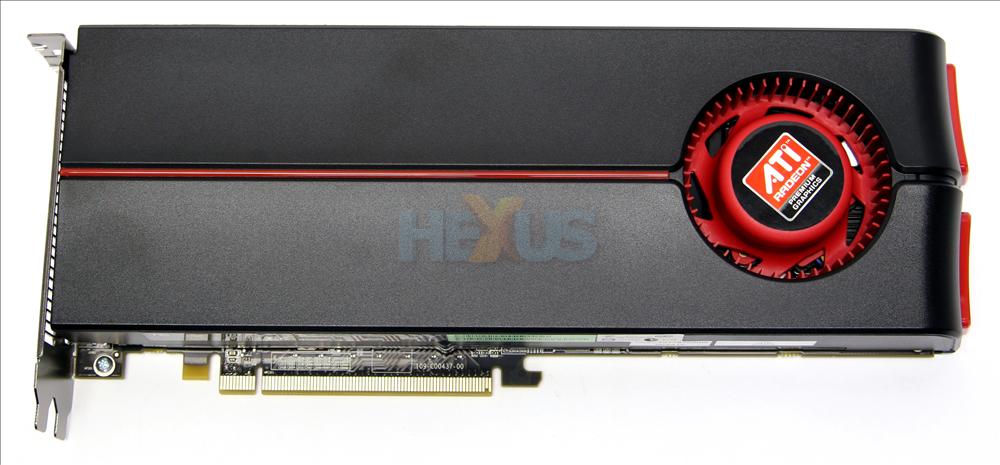
AMD's card look familiar? It should, as it's almost identical to the standard Radeon HD 5870 introduced back in September 2009. Readers wanting to know more about the architecture that makes the card tick can do so in our in-depth Radeon HD 5870 review.
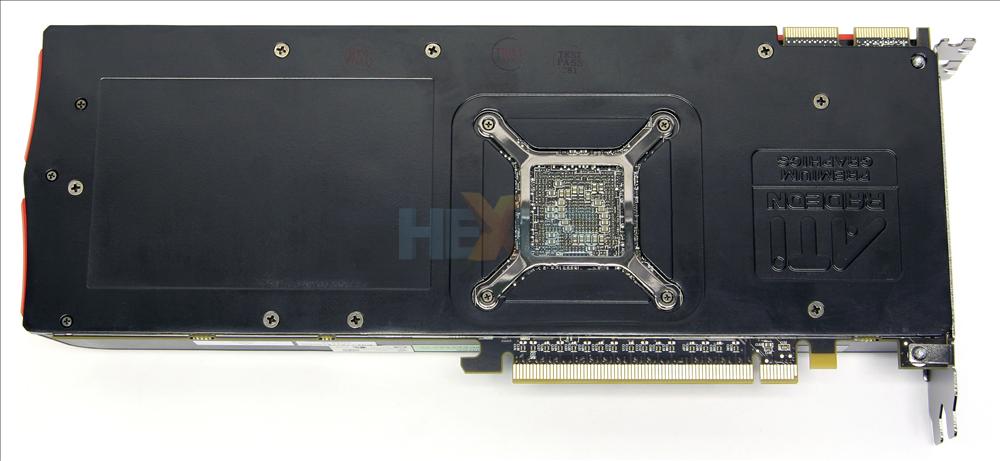
Cutting to the chase, the Radeon HD 5870 Eyefinity 6 Edition - which should be priced at around £400 - features the same 850MHz GPU as the standard Radeon HD 5870, but there's a significant change under the hood. Doubling up on the original design, AMD equips the Eyefinity 6 Edition with a massive 2GB frame buffer that should prove to be useful when gaming at mega-high resolutions.
Keeping to reference speeds, the GDDR5 memory operates at an effective 4,800MHz and connects via a 256-bit bus.
With 2.72 teraFLOPS of processing power on tap, AMD's fastest GPU should be potent enough to power Eyefinity's ultra-high resolutions. Those who're feeling a little bit adventurous, though, can daisy chain additional horsepower via the card's CrossFire links.
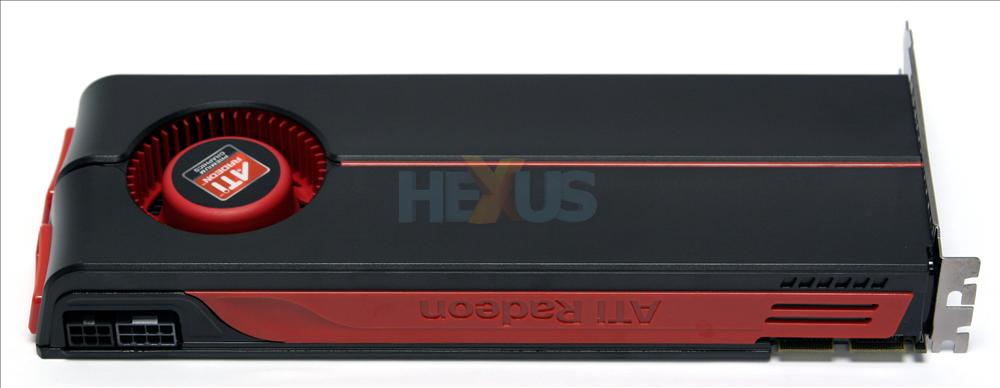
That's new, too. Requiring a little extra in terms of power, the 2GB Radeon HD 5870 Eyefinity 6 Edition necessitates both six-pin and eight-pin PCIe connections, as opposed to two six-pin connectors on the standard 1GB alternative.
As a result of the larger frame buffer and its ability to power six displays, the card pulls more power than a standard 5870, drawing 228W under full load and 34W when idle. An increase of 40W and 7W, respectively.
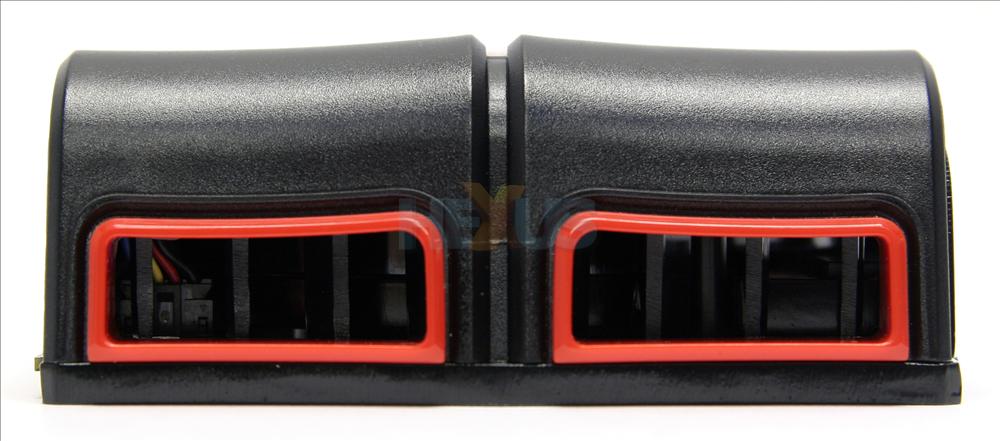
The minor bump in power draw doesn't necessitate a change in cooler.
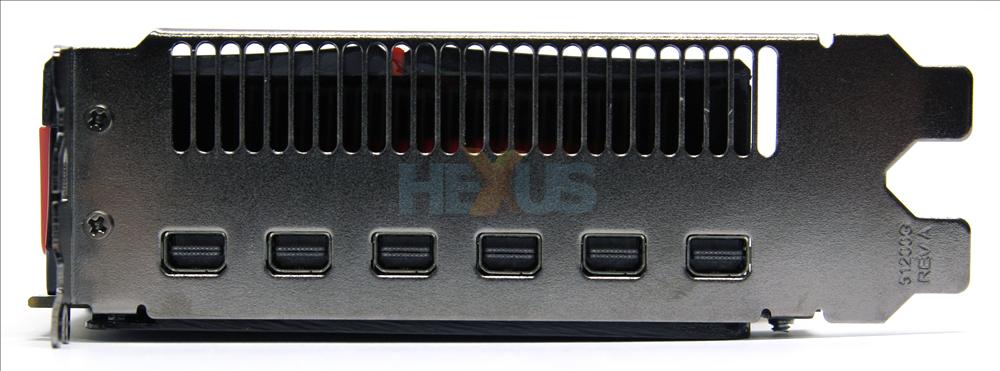
It's all change at the rear of the card, though. Out go AMD's original array of dual-link DVI, HDMI, and DisplayPort outputs, and in come six Mini DisplayPort connectors made possible by multiple DisplayPort pipelines attached to the GPU.
Using the supplied adapters, the Eyefinity 6 Edition card supports only two legacy (DVI, VGA or HDMI) displays, so you'll need to ensure you have DisplayPort connectivity on the majority of your monitors. Users aren't required to use all six outputs, of course, but there's a distinct sense of gratification in knowing that you have the ability.
And here's what makes the card special. Multi-monitors configurations aren't exactly new, the technology has been available for some time via multiple GPUs, and AMD's existing range of Radeon HD 5000-series products are already able to power up to three displays at once. The Eyefinity 6 Edition, however, is the first single consumer graphics card able to power six displays.
Why haven't we seen a card try to do it before? Quite simply, prior GPUs haven't had the power available to drive 3D gaming across half-a-dozen displays - AMD reckons its fastest GPU, Cypress, is the first to offer enough performance for massive multi-monitor setups.
Users can connect one, two, three, four or six monitors (not five, curiously) in an array of configurations. And no, CrossFire configurations won't support 12 monitors. Officially, the card supports a maximum theoretical resolution of 8,192x8,192 - though, even with six 30in 2,560x1,600 displays in a 3x2 landscape configuration, you're only going to hit 7,680x3,200. It's time to find some higher-res desktop wallpapers, folks, 2,560x1,600 just won't cut it anymore.
Source : HEXUS.net
Wednesday, April 7, 2010
AF-S Nikkor 70-200mm f/2.8G ED VR II

Balanced: The new 70-200mm f/2.8 is radically redesigned, both internally and externally.
CAN Nikon’s update to the classic 70-200mm f/2.8 improve on the original?
There are a few lenses which every Nikon owner always aspires to own — currently, that’s the 14-24mm f/2.8, the 24-70mm f/2.8 and 70-200mm f/2.8, all of which cover everything from the extreme wide-angle range to the telephoto.
Of course, being the top of the Nikon line of zoom lenses, the price is equally astronomical — the 14-24mm for example, has a list price of RM6,888 while the 24-70mm f/2.8 lists for RM6,688.
Nevertheless you always get what you pay for and without a doubt, these lenses are pretty high up there in terms of build quality and corner-to-corner sharpness.
Which brings me to the AF-S Nikkor 70-200mm f/2.8G ED VR II — the most recent (and quite major) update to the popular AF-S VR Zoom-Nikkor 70-200mm f/2.8G IF-ED which was released in 2003.
So the question is whether Nikon can improve on an already classic lens design and make a lens even more drool-worthy than its predecessor.
Design
The first thing you’ll notice about the new Nikkor 70-200mm f/2.8G is that the design is quite radically changed from the original.
Instead of a large front cylinder which tapers as it goes towards the lensmount, the new design is nearly a constant diameter until it reaches the lensmount.
The new 70-200mm is also a tad heavier than its predecessor — at 1,530g compared to the old one which was 1,470g, there’s not a big difference, but hints at the internal changes that have taken place.
Indeed, the internal lens elements have been redesigned and now features 21 elements in 16 groups, of which seven of those are ED (extra-low dispersion) elements and one featuring Nikon’s Nano Crystal Coat (both of which mean the new lens is more resistant to chromatic aberrations and flare than ever before).
Just to compare, the older version featured 21 elements in 15 groups with only five ED elements and no Nano Crystal Coat.

SIDE BY SIDE: A comparison between the old (right) and the new versions of the 70-200mm f/2.8 shows that the new one is slightly shorter but slightly thicker.
The overall length of the lens is now different as well with the new 70-200mm being slightly shorter than its older sibling.
Handling is pretty similar between the old and new versions, despite the differences in width.
There is one major difference between the old and the new lens. The new 70-200mm f/2.8 omits the focus lock buttons near the front element of the lens which served as a quick way to lock focus when you’ve pre-focused at a certain point and don’t want the camera wasting time trying to focus every time you depress the shutter release.
Of course, this is somewhat mitigated these days since nearly all modern pro and semi-pro Nikon DSLRs have a dedicated autofocus button so you can separate the autofocus away from the shutter release in the Custom function settings.
Lastly, the new 70-200mm now focuses slightly closer, at 1.4m throughout the zoom range compared with 1.5m on the older version.
Oh yes, apparently Nikon has also improved the Vibration Reduction (VR) system on the lens, and now claims up to a four-stop improvement when shooting at slow shutter speeds, compared with three-stops on the older model.
Of course, the effectiveness of the image stabilisation technology also depends on how steady you can hold the camera but we generally managed to take shake-free images at as low as 1/10sec even zoomed out all the way to 200mm.
Quality
At this price level, the quality and sharpness you get are top-notch in both the new and old versions of the 70-200mm. Any differences are actually quite minor as both versions of this lens are extremely sharp throughout the zoom range, especially when stopped down a little from maximum aperture.

SHORTER: The new Nikon 70-200mm f/2.8 is shorter, but chubbier version of its predecessor.
If you’re using a Nikon DSLR with an APS-C size sensor (such as the D300, D300S, D90, etc) you’re not going to see any difference at all in quality between the old and the new 70-200mm even with the aperture wide open at f/2.8.
Having said that, there is a difference when you’re using a full-frame 35mm Nikon like the D3S, D3X and D700 where the larger sensor means that you’re really looking much further into the corners of the image circle than on an APS-C camera.
In our tests using the D700 as the test camera, we found that wide open at f/2.8, the new 70-200mm f/2.8 slightly but noticeably trumps its older sibling in the corners, offering a tad more sharpness in the corners than the older version.
In the centre, there was no difference at all in terms of resolution — both lenses produced extremely sharp results even wide open so there’s no complaints there at all.
Stopped down to f/5.6 and f/8, both lenses are practically neck-and-neck, and any difference in the corners is now gone, with both lenses exhibiting corner-to-corner sharpness.
As usual, if you want to have a look at these shots and compare them yourself, visit bit.ly/25J5c and download the full-sized images to compare for yourself.
Dell unveils Vostro 3000 series

Vostro 3700
Dell has unveiled its Vostro 3000 series notebooks, which sport the latest Intel Core processors, including the Core i7 quad-core processor on the high-end Vostro 3700 model.
The Vostro 3300, on the other hand, is a 13in notebook with an integrated optical drive.
And for those that cannot afford to be chained to their desks, the 14in Vostro 3400 offers up to eight hours of battery life with an optional nine-cell battery.

Vostro 3500
As for the Vostro 3500 and Vostro 3700, both offer high definition WLED screens while the 3700 offers the option of a 1GB nVidia GeForce discrete graphics card.
The Vostro 3000 series notebooks also sport durable hinges and are encased in aluminium for extra protection.
Other features include an integrated webcam and microphone, remote on-call support, wireless capabilities with a full range of connectivity options such as 802.11g/n wireless LAN, Bluetooth, and WWAN (wireless wide area network) mobile broadband.
The pricing for the Vostro 3000 series notebooks start from RM2,379 (USD 799) onwards.
Subscribe to:
Comments (Atom)